
Last updated November 15, 2026
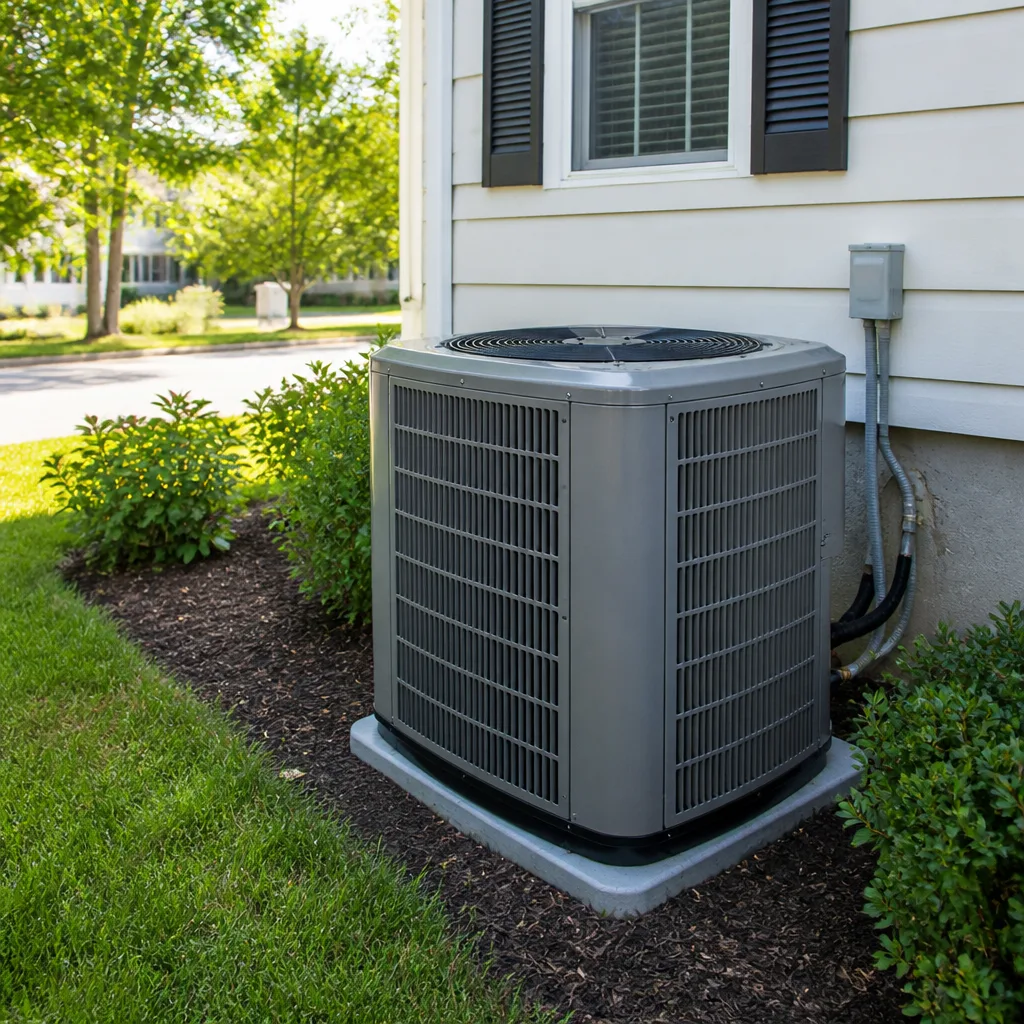 AC repair
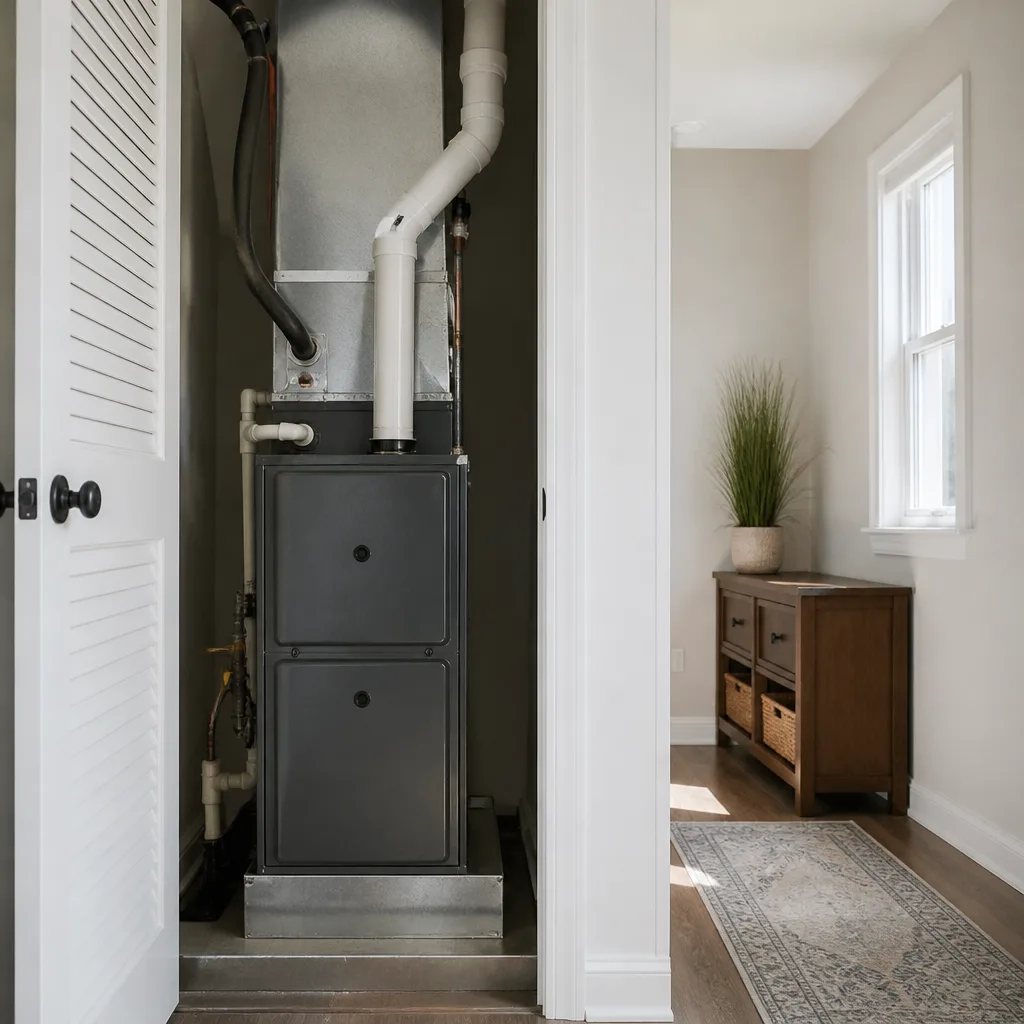 Furnace & heating
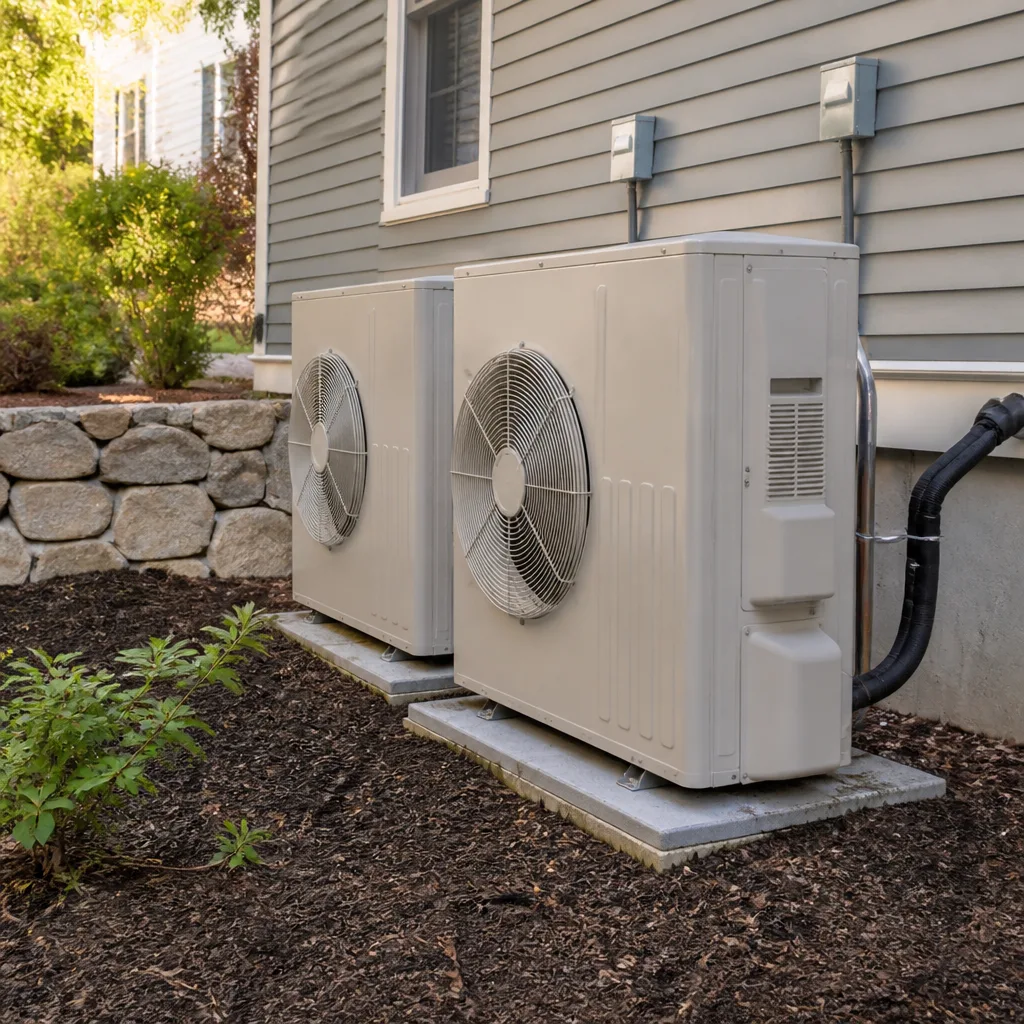 Heat pumps
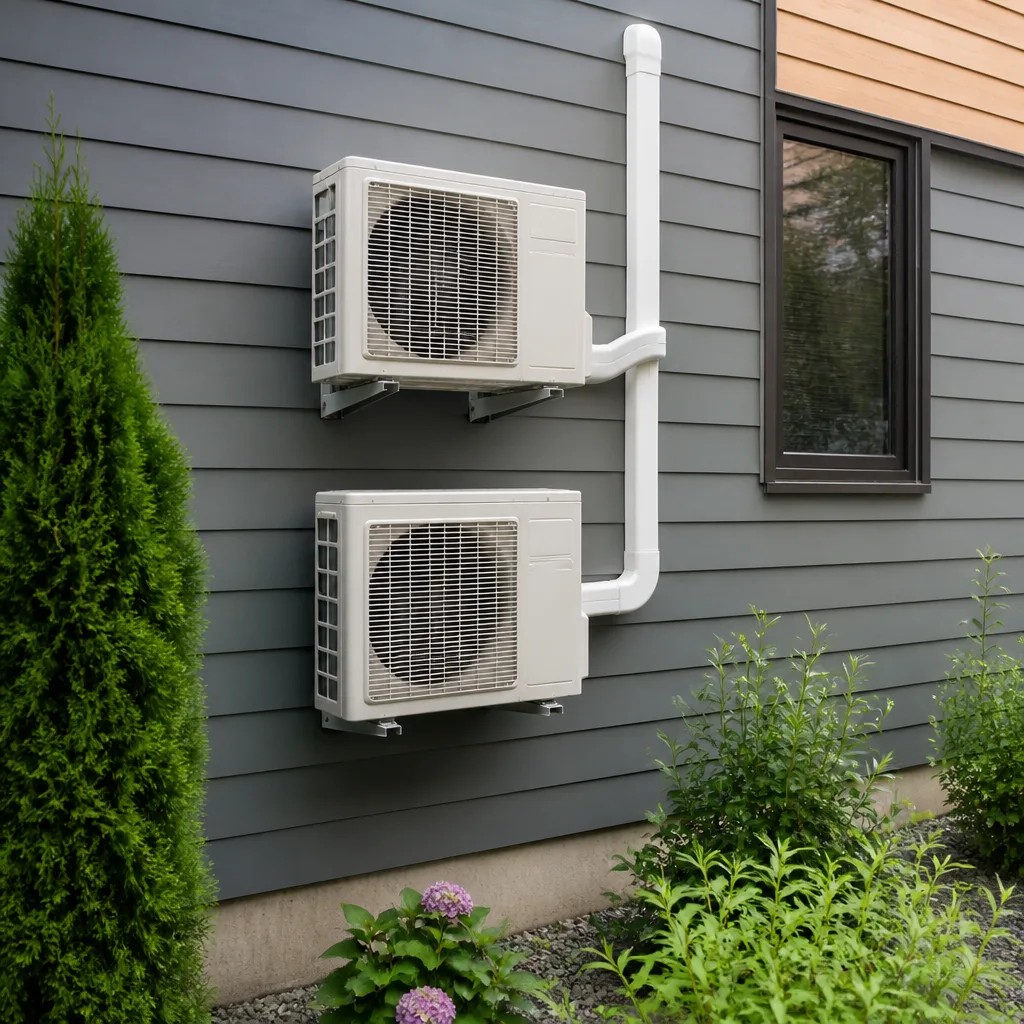 Ductless mini splits
 Carrier
 Trane
 Goodman
Seasonal tune-up and full diagnostic on your Carrier, Trane, or Goodman system - readings shown to you before any repair is proposed
Diagnosis first, numbers second - you approve the repair price before a single part goes in.
Get your free estimateDIY vs Professional HVAC: The Palm Bay Homeowner’s Decision Guide
Most homeowners frame the do-it-yourself question around skill. Can I handle this? That’s the wrong first question in Palm Bay. The more important variable is legal exposure. And your home’s build and your system’s age sit right alongside it. Replacing a failed capacitor on your air handler is legal, cheap, and genuinely within reach for a careful homeowner with a basic multimeter. Touching the refrigerant circuit without an EPA Section 608 certification is a federal violation no matter how confident you are, and it can void the manufacturer warranty on a system that isn’t old enough to replace. This guide maps those lines precisely in Palm Bay, Florida: what you can safely and legally do yourself, what you can’t, and how to narrow down a problem before you call anyone.
Quick Answer
In Palm Bay, homeowners can legally and safely handle filters, thermostat batteries and wiring, condensate drain clearing, and often capacitor or contactor replacement on their own. Anything involving the sealed refrigerant circuit, compressor diagnostics, or high-voltage panel work requires a licensed HVAC professional and, in most cases, a permit. Even when you’re capable of the repair, DIY can cost more in voided warranties and repeat failures than the professional call would have, so reserve it for the handful of low-risk parts on the outside of the system.
Styles & brands we work with
- AC repair
- Furnace & heating
- Heat pumps
- Ductless mini splits
- Carrier
- Trane
- Goodman
Table of Contents
- Where Florida Law and Federal Rules Draw Hard Lines
- The Warranty Math Nobody Runs Before Starting
- What Palm Bay Homeowners Can Legally DIY
- How to Diagnose Before You Call: Codes and a Multimeter
- Where DIY Delays Actually Cost More in Palm Bay
- Finding the Real Labor Savings in Brevard County
- When It’s Time to Stop and Call a Professional
Where Florida Law and Federal Rules Draw Hard Lines
There are three separate rule systems acting on your HVAC system at the same time, and they don’t care whether you’re handy. Federal rules control refrigerants. State and local rules control permits and licensing. Manufacturer terms control warranty coverage. Miss any one of them and the legal, safe repair suddenly becomes an expensive problem.
Start with refrigerant. Under the Clean Air Act, anyone who services, maintains, or disposes of equipment containing regulated refrigerants must be EPA Section 608 certified. That covers adding refrigerant, recovering it, evacuating a system, and opening the sealed circuit at all. There’s no homeowner exemption for R-410A or R-32 systems. Buying a can of refrigerant at a parts house and topping off your own unit is not a legal workaround; the sale itself typically requires certification, and any discharge to the atmosphere is a violation. If your system is low on charge, the problem is a leak, and a leak is a professional diagnosis every time.
Next, permits and licensing. Replacing a complete AC system or its major components typically requires a permit through Brevard County or the City of Palm Bay, and that permit requires a licensed contractor to pull it and pull it correctly. Homeowners can sometimes pull permits for their primary residence, but an HVAC permit requires the contractor’s license attached. Contractors are licensed through the Florida Department of Business and Professional Regulation and the Construction Industry Licensing Board. If you’re ever unsure who’s legitimate, verify the license number directly on the DBPR site before work starts.
Finally, electrical work. Your air handler and condenser draw serious amperage, and panel connections, breaker replacements, and new line runs are not homeowner territory. If a breaker trips repeatedly, the right move is a licensed electrician or an HVAC technician who can isolate whether the fault lives in the wiring or the equipment. That boundary isn’t about competence. It’s about fire risk.
The Warranty Math Nobody Runs Before Starting
Here’s the part that surprises homeowners most. A manufacturer warranty is a contract, and DIY work can void it. Most Carrier, Trane, Lennox, and Goodman equipment sold in the last decade comes with a parts warranty lasting five to ten years, and a compressor warranty that often runs longer. Those terms almost universally require installation and repair by a licensed contractor. Open the system yourself, or hire an unlicensed handyman, and the manufacturer can deny the claim when the compressor fails two years later.
Run the numbers honestly. If a $400 DIY repair saves you a $250 labor charge but voids a $2,000 compressor replacement that would have been covered in year four, you lost money. That math gets worse with every year the equipment has left on its warranty.
Warranty terms also affect which parts are legal to source. Many distributors won’t sell you a warranty-replacement part without proof of contractor status. This is one reason we work on all nine major brands, including Carrier, Trane, Lennox, Goodman, Rheem, York, Daikin, Bryant, and American Standard: the warranty path is knowledge-based, not brand-exclusive. The right system for your home, not for our margins, means we’re checking the warranty status on your specific model before we recommend anything.
A practical warranty checklist before touching your system:
- Locate the model and serial number plate on the outdoor condenser.
- Find the original installation paperwork or warranty registration.
- Confirm the coverage period for parts, compressor, and labor (if purchased).
- Read the warranty exclusion for “unauthorized repair” or “non-professional service.”
- If your system is under ten years old, assume the warranty is live until proven otherwise.
If all five of those cornerstones are unclear, err toward professional repair. The cost of a service call is usually smaller than the cost of losing coverage on a ten-year-old condenser.
What Palm Bay Homeowners Can Legally DIY
The legal, safe DIY list is shorter than what YouTube suggests, but it isn’t empty. There are real repairs a homeowner can handle without a license, without a permit, and without voiding a parts warranty, because they’re external to the system’s sealed refrigerant and electrical code coverage.
Here’s the definitive list for Palm Bay:
Air filter replacement. No license needed, no permit, no warranty impact. Difficulty: easy. Use MERV 8 to MERV 11 in most systems. A clogged filter causes the most common AC complaint: inadequate cooling and a frozen evaporator coil. Change it every 30 to 90 days in Brevard County’s high-pollen seasons and constantly running summer months.
Thermostat batteries and battery wiring. Changing batteries is trivial. Low-voltage thermostat wiring (typically 18 to 24 gauge, 24V control wires) can be replaced or swapped to a new thermostat by a careful homeowner. It’s low-voltage and doesn’t require a permit. The risk here is mis-wiring, which can blow a low-voltage transformer, so photograph the terminal wiring before you disconnect anything.
Condensate drain line clearing. A wet vacuum on the outdoor drain stub, or a flush of the trap line, will clear most drain clogs. This is the most common problem in Palm Bay’s humidity and the easiest to DIY. A 3/4-inch PVC line runs from the indoor unit to a drain location or the exterior. Difficulty: easy. Use a shop vac rated for wet use and confirm the line flows before you call it done.
Capacitors and contactors. Both are external electrical components on the condenser or air handler. Replacing a start or run capacitor is legal and does not touch the sealed refrigerant circuit. Difficulty: moderate, because stored charge must be safely discharged first. Never touch the terminals on a capacitor until it’s been verified with a multimeter and discharged into a resistor. A contactor replacement is similar: kill the disconnect, discharge, swap the part, verify the coil voltage matches. Sourcing: online HVAC parts retailers or a local electrical supply house. Match the microfarad rating and voltage exactly; a mismatched capacitor will fail fast.
Condenser coil cleaning. Rinsing the outdoor coils with a garden hose, on the fins, from the top down without bending them, is safe. Do it with the breaker off. Palm Bay’s windy, sandy environment means outdoor coils load up with grit faster than in more humid, stiller climates, so this is a twice-a-year task here.
If you want help on AC installation rather than maintenance, that path is not DIY and never will be. Installation requires a permit, a licensed contractor, and a system that’s sized and loaded correctly for your home, which is a calculation, not a handyperson task.
How to Diagnose Before You Call: Codes and a Multimeter
Diagnosing a problem is a separate skill from repairing it, and any homeowner can learn the diagnostic side. Here’s how the sequence goes when we’re on a call, and how you can follow most of it yourself before deciding to schedule anyone.
- Read the thermostat first. Look for a blank screen (power issue), a “Fan On” setting (running but not cooling), or an error code on a smart thermostat. Write the code down.
- Check the air handler for a flashing light. Most modern systems have a control board with an LED diagnostic code. Count the flashes between pauses. Find the flash pattern in your unit’s owner’s manual or on the sticker typically inside the access panel. That code narrows the problem to a general category: high-limit trip, flame rollout, pressure switch, blower issue, or thermistor failure.
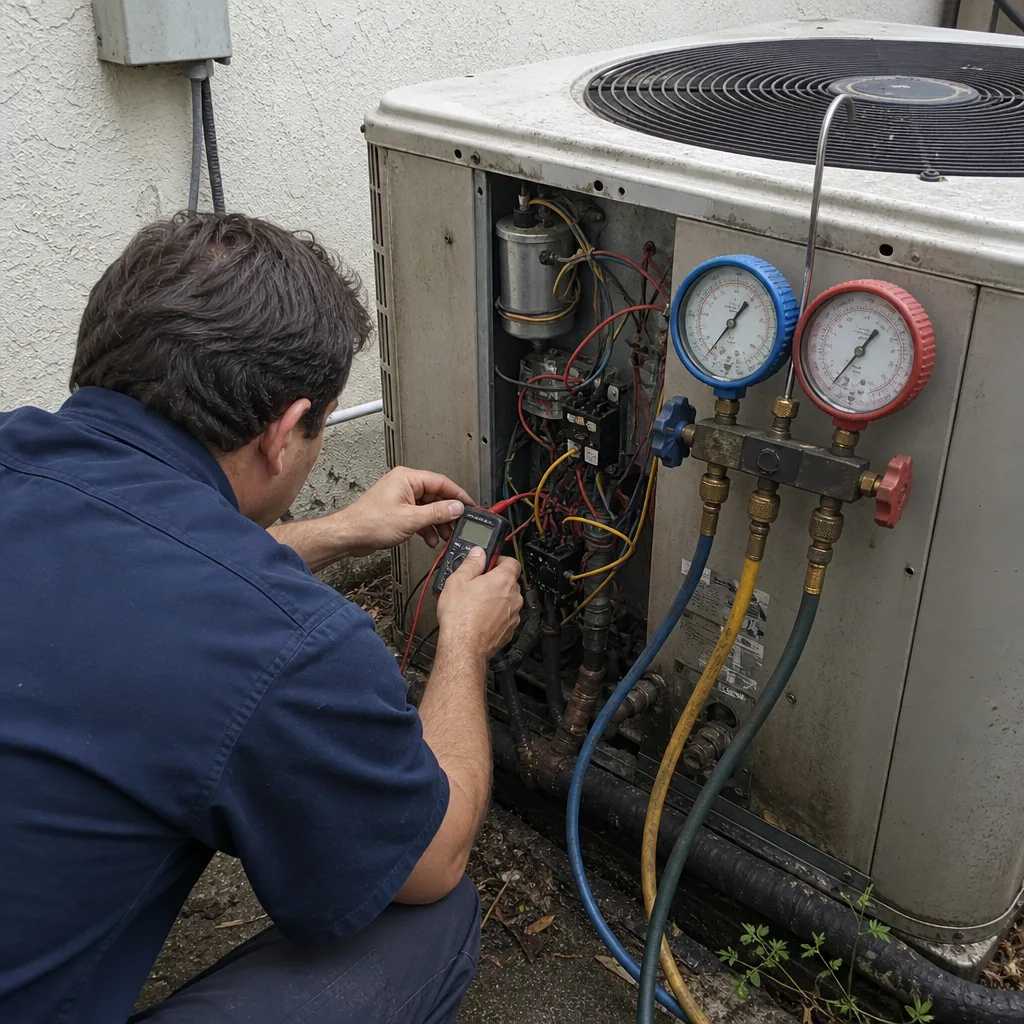
- Pull the condenser’s access panel, breaker off, and inspect. Burnt wires, bulging capacitors, or a tripped high-pressure switch all point at different diagnoses. Look, don’t touch, until the breaker is locked out.
- Use a basic HVAC multimeter. The two useful readings for a homeowner are line voltage at the condenser disconnect (should measure 240V on a standard residential split system) and microfarads on a capacitor (compare the reading to the rating printed on the part). If the reading is more than 10% off the rated value, the capacitor is probably bad. That’s the test that most often converts a “call a pro” into “buy a $30 part.”
- Check voltage at the contactor coil with the thermostat calling for cooling. If 24V is present at the coil but the contactor won’t close, the contactor itself is bad. If 24V isn’t present, the problem is upstream in the thermostat wiring, low-voltage fuse, or the control board.
This diagnostic process saves you the diagnostic call for the easy stuff, and it saves you time explaining the problem to a technician when it isn’t easy. We hear plenty of Palm Bay homeowners describe the flash code before we arrive, and it makes the visit faster. It’s one reason furnace repair discussions on the heating side are often shortened by the same technique: the diagnostic code on the board is what points at the flame sensor, igniter, or pressure switch.
Where DIY Delays Actually Cost More in Palm Bay
The real financial risk of DIY isn’t the cost of the wrong part. It’s the secondary damage that happens while you’re figuring out the first problem. Three scenarios cause the most expensive delays in this market.
Refrigerant leaks. A system that’s low on charge because of a slow leak can run for months with a homeowner topping it up. Every month it’s undercharged, the compressor runs hotter and longer, and the oil may not return properly. Compressors fail from this, and compressor replacement is the most expensive repair in residential HVAC. It’s also the one that a licensed leak detection and repair eliminates. Refrigerant leaks are not a DIY problem legally or practically.
Electrical faults that trip breakers repeatedly. A homeowner resets the breaker, the breaker trips again, they reset it again. Each reset is a chance for a shorted component to arc and damage a board or start a fire. If the breaker trips more than once, stop resetting it and have the circuit checked. Repeated resets are the single most dangerous DIY habit we see in Palm Bay.
Coil issues driving mold growth. An evaporator coil that’s dirty or icing over stays wet. In a climate where indoor humidity runs high for months, a wet coil and a wet drain pan become a microbial growth environment. That problem compounds: the growth restricts airflow, the system works harder, and the coil eventually has to be cleaned or replaced. A coil or drain issue that a homeowner ignores for a year routinely costs two to three times what it would have if addressed in the first month.
The pattern across all three: the repair cost is usually smaller than the resulting damage. In Palm Bay, the combination of year-round cooling demand and high humidity means DIY delays have less slack than in a climate with a real off-season. Palm Bay homes run their AC closer to 10 or 11 months of the year than 6, so a system that’s running wrong is running wrong a lot.
We work on your brand, so if your system is a Carrier, Trane, Lennox, Goodman, or any other named brand, the diagnostic visit will center on the equipment you own. Heating and cooling, handled. One call covers it.
Finding the Real Labor Savings in Brevard County
The honest answer to “how much do I save doing it myself?” depends on whether you’re comparing a like-for-like repair. Here’s how the math works in the current Brevard County market, expressed as typical ranges rather than exact prices, because the written estimate sets the final number.
- Run capacitor replacement: DIY part cost low; professional job typically a modest flat rate covering the part plus diagnostic-lite. Saving: real but small, in the range of a typical service call.
- Contactor replacement: DIY part cost low; professional job similar to a capacitor, with a slightly higher labor portion. Saving: real but small.
- Condensate drain clearing: DIY near zero; professional job modest. Saving: solid, and worth learning.
- Blower motor replacement: DIY part cost moderate, plus risk of mis-wiring a 240V circuit. Professional job mid-range. Saving: not worth the risk for most homeowners.
- Refrigerant leak detection and repair: Not DIY legal. Saving: none, because DIY isn’t an option.
- Compressor replacement: Not DIY legal. Saving: none, on labor; a professional job is often better than a homeowner attempting it and causing a unit replacement.
- Full system replacement: Not DIY. Saving: none, and possibly negative if an unpermitted install surfaces during a home sale.
The honest way to find the real labor savings is to get a written estimate and compare it against the price of the part plus your own time. Then subtract the warranty exposure. If the system is under ten years old, the “savings” from DIY on any part on the sealed side is likely negative after warranty risk. On the parts side, which is what’s actually legal to touch, the savings are genuine but modest. That’s the trade.
If you’re shopping for a system or comparing an AC installation, we’d rather you know this before you decide than after. Our technicians have up to 10 years of experience, and that experience is spread across competing equipment platforms, not a single product line. If you want a second opinion on the Flagship AC Repair standard of work, we’re glad to give you the plain-language version.
When to Call a Professional
Call a professional for anything related to refrigerant, the compressor, high-voltage electrical, control board diagnostics that go beyond the flash code, and any repair on a system still under manufacturer warranty. In Palm Bay, that covers a lot of routine work. If your unit isn’t cooling and the outdoor fan isn’t spinning, or the indoor blower won’t turn on, or the breaker trips more than once, it’s time to schedule a technician.
Also call a professional if the problem is intermittent. A system that cools and stops, cools and stops, may be a pressure switch, a thermostat, or a failing capacitor, and a trained diagnosis is faster than guessing. The right parts were never cheap, and the wrong part is expensive.
Flagship AC Repair offers free estimates in Palm Bay. Call (888) 374-9181. We answer 24/7. Fast dispatch from 7am to 7pm, Sunday through Friday. If you’re comparing repair to replacement, we’ll give you the honest math on both rather than steering you to the bigger job. That’s the Flagship-level work we hold ourselves to.
See the difference
 Before
 After
 Before
 After
 Before
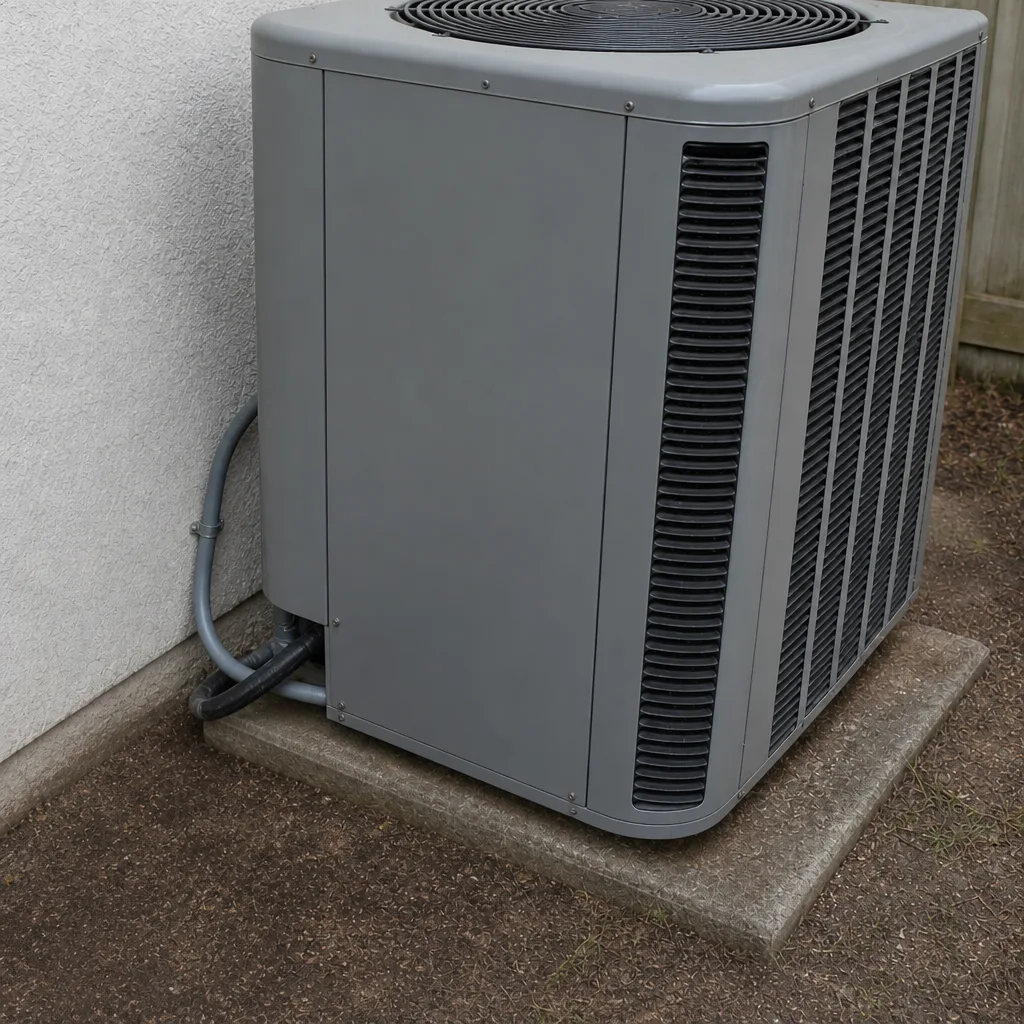 After
Common Mistakes to Avoid
- Resetting a tripped breaker more than once. A repeated trip means something is shorted. Resetting it again is how small problems become electrical fires. Have the circuit checked.
- Topping off refrigerant without finding the leak. This is a federal violation for uncertified handling, and it’s also a mechanical mistake: a slow leak that isn’t fixed will keep losing charge, and the compressor pays for it.
- Replacing a capacitor by rating alone. Voltage, capacitance, and microfarad tolerance all need to match the original part. A mismatched capacitor will work briefly and then fail.
- Skipping the permit on major work. An unpermitted AC system replacement in Palm Bay can surface during a home inspection or sale and cost far more than the permit itself. Always verify a contractor’s DBPR license before the work.
- Ignoring a dirty drain pan in high humidity. A wet pan that isn’t draining clears out airflow and creates a biological growth problem. Clean the pan and clear the drain line as part of routine maintenance.
- Cleaning coils with a pressure washer. High pressure bends condenser fins and destroys them. A garden hose is the right tool.
- Buying parts on a warranty system without calling the manufacturer first. A covered part may be free if you go through the warranty channel, and bought-and-paid-for-the-wrong-version is expensive.
Frequently Asked Questions
Yes, for external parts like capacitors, contactors, filters, thermostat wiring, and condensate drain lines. It is not legal to handle refrigerant, open the sealed refrigerant circuit, or perform electrical panel work without proper licensing and EPA certification. If the job is on the sealed side, call a licensed professional.
Yes, and it’s one of the most reasonable DIY repairs. The part is inexpensive and the job takes under an hour for a careful homeowner. Discharge the stored charge first with a multimeter and a resistor, and match the microfarad and voltage ratings exactly. If you’re unsure about any step, call (888) 374-9181 for an exact quote, since estimates are free.
It can. Most manufacturer warranty terms require professional, licensed installation and repair. Opening the sealed system yourself, or using an unlicensed contractor, can void a parts or compressor claim. Check the original warranty paperwork before touching anything, especially if the system is under ten years old.
Look for the LED status light on the control board inside the air handler access panel. Count the flash sequence between pauses, then check the owner’s manual or the sticker inside the panel for what that code means. It narrows the diagnosis to a category, not a specific part.
Repeated breaker trips usually mean a short in the circuit, a failing compressor, or a bad contactor. Reset it once. If it trips again, stop resetting and have a professional inspect the circuit. Each reset risks further damage.
Diagnostic pricing is set per job by the written estimate, and we provide free estimates. Call (888) 374-9181 for an exact quote. The final price is always the written number.
The Bottom Line
The DIY decision in Palm Bay isn’t really about your skill level. It’s about three walls you can’t move: refrigerant handling, permits and licensing, and manufacturer warranty terms. Inside those walls, there’s real work you can do well: filters, capacitors, contactors, drain lines, thermostat wiring, and coil cleaning. Outside them, the money you save on a service call is usually less than the money you lose on a warranty claim or the secondary damage a delay causes. Diagnose what you can. Repair what’s legal and safe. Call a professional for the rest. That’s Flagship-level work, and one call covers it.
Written by the team at Flagship AC Repair.